



History of the Santa Teresa Fortress
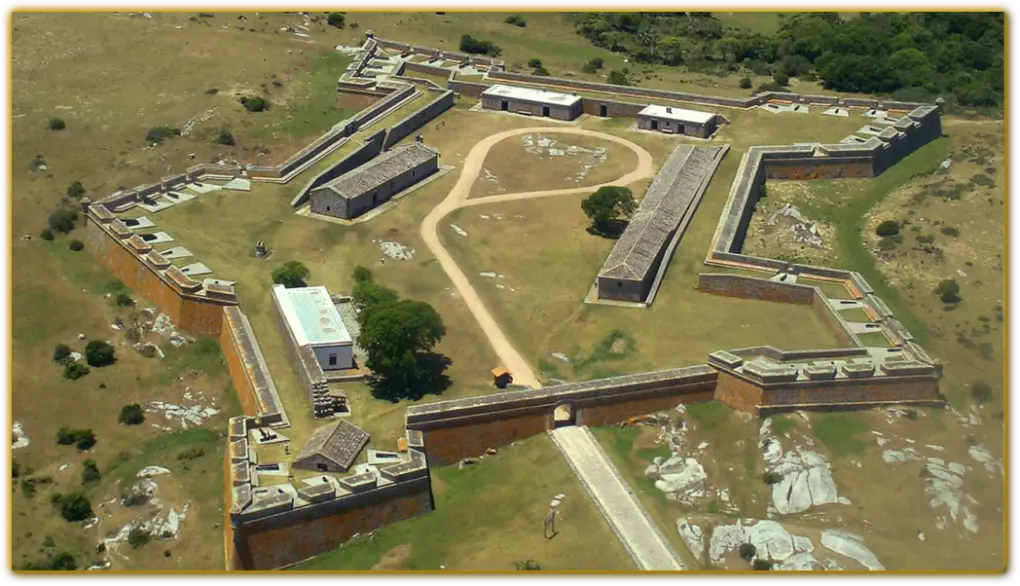
The restoration of the Santa Teresa Fortress, carried out between 1892 and 1942, was a long and complex process that involved decrees, revolutions, honorary commissions and the determination of figures such as Horacio Arredondo.
Thanks to the political will of several presidents and the efforts of military personnel, architects and historians, the fortress ceased to be an abandoned structure threatened by sand dunes and became a symbol of national memory.
The Santa Teresa Fortress was declared a National Historic Monument by Law No. 8,172 on December 26, 1927, marking a turning point in its preservation.
Nearly a century later, Santa Teresa National Park itself was declared a National Historic Monument by Resolution No. 298/024 of the Ministry of Education and Culture (MEC), published in November 2024.
This designation protects not only the fortress but also the broader cultural landscape, including historical buildings, archaeological sites, native vegetation, and the coastal environment, reinforcing the park’s significance as a unique heritage site in Uruguay.
Located in Rocha, Uruguay, the Santa Teresa Fortress stands today as one of the most significant historical landmarks in the country, linking military history with natural heritage.
- Located 40 m above sea level, 900 m from km 303 of Route 9 (former Angostura Road).
- Between Punta del Diablo and La Coronilla, in the department of Rocha.
- 2 km from the Atlantic Ocean and 5 km from Laguna Negra.
- It is part of the Santa Teresa National Park, created to protect it.
- Declared a National Historic Monument in 1927, it is under the jurisdiction of the Historical Studies Department of the Army General Staff.
- 1762 – First Portuguese work: Colonel Tomás Luis Osorio, plans by João Gómez de Mello. Trench and log siege at Castillo Chico.
- 1763 – Second Spanish fortification: Pedro de Cevallos takes Santa Teresa and San Miguel. Engineer Francisco Rodríguez Cardozo designs a new work.
- 1765–1775 – Definitive fortress: French engineer Bartolomé Howel. Irregular pentagon with five bastions, perimeter of 642 m.
- 1777 – Treaty of San Ildefonso: ratifies Spanish possession of Santa Teresa and San Miguel.
- 1811: Occupied by patriots, later invaded by the Portuguese. First link in the Eastern Exodus.
- 1825–1828: Actions by Colonel Leonardo Olivera against the Brazilian imperial forces.
- 1830–1843: Watchtower on the border during the presidencies of Rivera and Oribe.
- 1895: Converted into a prison.
- End of the century: Abandonment, looting of stones, and encroachment of the dunes.
- President of the Eastern Republic of Uruguay Julio Herrera y Obes (1892): first reconstruction decree.
- President of the Eastern Republic of Uruguay Juan Idiarte Borda (1895): ratifies the decree; the revolution destroys part of the work.
- President of the Eastern Republic of Uruguay Baltasar Brum (1919–1923): Horacio Arredondo promotes the restoration; the first Honorary Commission is created.
- President of the Eastern Republic of Uruguay José Serrato (1923–1927): difficulties in the first Commission.
- President of the Eastern Republic of Uruguay Juan Campisteguy (1927): National Monument, second Commission and creation of the Park.
- President of the Eastern Republic of Uruguay Gabriel Terra (1931–1938): reports and restoration work on walls, court, powder magazine, chapel and parade ground.
- President of the Eastern Republic of Uruguay Alfredo Baldomir (1938–1942): completes the restoration and consolidates the Santa Teresa Park.
- Irregular pentagon with five projecting bastions.
- Granite walls up to 11.5 m high and 4 m thick.
- 41 embrasures for cannons and 5 guard towers.
- Main gate to the West and emergency gate to the East.
- Capacity for 300 men.
- Restored colonial buildings: flag room, guardhouse, chapel, courtyards, powder magazine, and dungeons.
- Salas temáticas: Comandância, Paiol, Capela, Restauração, Ferraria, Cozinha, Enfermaria, Quadras.
- Camposanto e povoado de Santa Teresa, com até 128 habitantes na época colonial.
- San Miguel Fort (1737): square plan with four bastions, less resistant than Santa Teresa. Declared a National Monument in 1937.
- Cerro Fortress (1809): protects Montevideo Bay and the lighthouse. Declared a National Monument in 1931, it has borne the name Artigas since 1882.
- Together, the three fortifications form the colonial defensive system of the Banda Oriental.
The restoration of the Santa Teresa Fortress, undertaken between 1892 and 1942, was a long and complex process that spanned decrees, revolutions, honorary commissions, and the tenacity of figures like Horacio Arredondo.
Thanks to the political will of several presidents and the efforts of military personnel, architects, and historians, the fortress ceased to be an abandoned monument threatened by the dunes and became a symbol of national memory.
Its declaration as a National Historic Monument in 1927 and the creation of the Santa Teresa Park, also declared a National Historic Monument in 2025, marked a turning point: since then, the fortress has not only been preserved as a testament to the colonial past but has also been integrated into a protected natural environment, open to the community and visitors.
Today, the Santa Teresa Fortress is a living space where history and nature interact, reminding us that preserving heritage is also a way of projecting identity and future.